
- Need Help?
 Virtual Appointment
- Book Appointment
- 0
 Your shopping cart is empty
Login to view previously saved items or track a recent order.
Login to view previously saved items or track a recent order.
 Back
Back09/11/2026
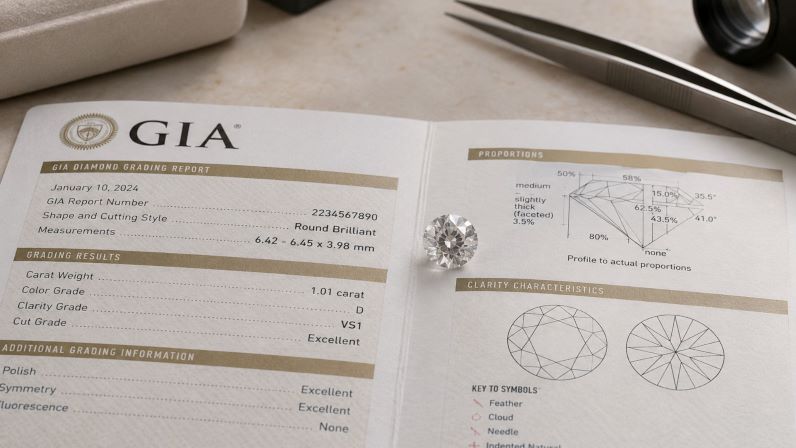
Every diamond certificate looks convincing. Official letterhead, a laser inscription number, a neat grid of letters and grades. But GIA, IGI and HRD Antwerp don't grade to identical standards, and the gap between them can genuinely change what you're paying for. Here's what each certificate actually tells you, where they differ, and which one to ask for depending on whether you're buying natural or lab grown.
A diamond certificate, or grading report, is an independent assessment of a diamond's 4Cs, carat weight, colour, clarity and cut, carried out by a gemological laboratory with no financial stake in the sale. It is not a valuation and it is not proof of authenticity alone; it's a standardised description that lets you compare two diamonds you've never seen side by side. The three labs that matter most for UK buyers are GIA, IGI and HRD Antwerp.
All three labs assess the same 4Cs, but they don't land on the same grade for the same stone. GIA is widely regarded as the strictest and most conservative grader in the industry, which is why it's treated as the benchmark everyone else is measured against.
IGI tends to be more generous, typically landing around one colour grade and one clarity grade higher than GIA would give the same diamond. HRD sits close to GIA, generally considered about 95% as strict, and remains the most recognised European lab, particularly across Belgium and the wider EU.
Grading Table at a Glance
| GIA | IGI | HRD Antwerp | |
|---|---|---|---|
| Founded | 1931, USA | 1975, Belgium/global | 1976, Antwerp |
| Best known for | Strictest, most conservative grading | Lab grown diamonds, high volume commercial stones | European natural diamonds |
| Natural diamonds | Gold standard, best resale confidence | Reliable, generally a touch more generous on colour and clarity than GIA | Close to GIA, about 95% as strict |
| Lab grown diamonds | Moved to a simplified Premium or Standard label in 2025, no letter grades | Full 4Cs grading, largest lab grown archive, recommended standard | Withdrawing from loose lab grown certification from 2026 |
| Typical grading gap vs GIA | Baseline | Around one colour and one clarity grade more generous | Roughly in line with GIA |
| Turnaround | Slower | Faster | Moderate |
These are general industry patterns rather than fixed rules, and grading can vary stone to stone. The point isn't that one lab is dishonest, it's that a G colour on an IGI report and a G colour on a GIA report aren't quite describing the same diamond.
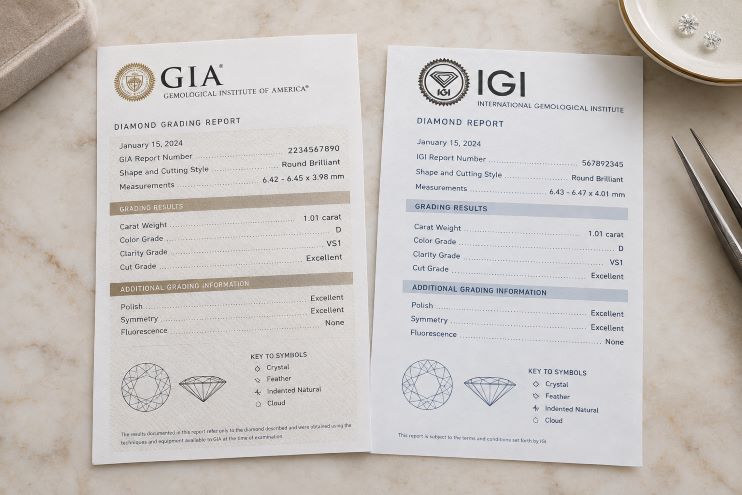
For a natural diamond, GIA remains the gold standard. Its grading is the most conservative in the industry, it carries the strongest resale recognition worldwide, and it's the certificate most trusted by insurers, auction houses and buyers on the secondary market. If you're investing in a higher value natural stone, a GIA report gives you the most protective, most internationally portable paper trail.
HRD is a close second for natural diamonds, close enough that a diamond graded HRD is generally trusted to a similar standard, and it's especially useful if you're sourcing or reselling within Europe. IGI is still a legitimate, well trained lab for natural diamonds, its grading is simply a little less strict than GIA's, so a stone's colour or clarity may read slightly better on an IGI report than it would on a GIA one for the same physical diamond.
The picture flips for lab grown diamonds, and this has shifted meaningfully in the last year. In 2025, GIA moved its lab grown reporting to a simplified Premium or Standard classification, which removes the individual letter grades buyers usually rely on to compare two stones. HRD is withdrawing from loose lab grown diamond certification from 2026 onward, keeping only a report for diamonds already mounted in jewellery.
IGI is the only one of the three still offering full 4Cs grading on loose lab grown diamonds, with the largest archive of lab grown reports in the industry and the fastest turnaround. For a lab grown diamond bought today, an IGI certificate is the one that actually gives you letter by letter detail to compare against other stones.
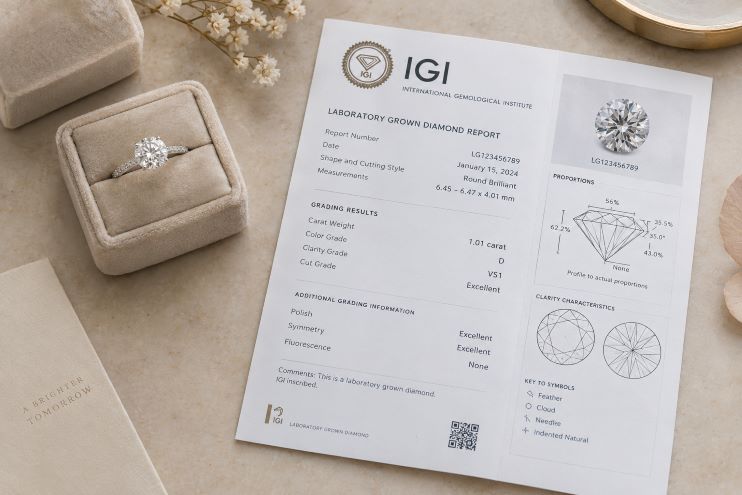
At Harmony Jewels, we work with both natural and lab grown diamonds, and we certify each to the lab that gives you the clearest, most reliable picture of that specific stone. For natural diamonds, we lean toward GIA as the most protective choice, with HRD a trusted alternative. For lab grown diamonds, IGI is currently the standard we recommend, since it's the only one of the three still offering full, granular 4Cs grading on loose stones.
Whichever lab issued it, focus on these sections first:
You can verify any certificate directly with the issuing lab, at gia.edu/report-check for GIA, igi.org for IGI, or my.hrdantwerp.com for HRD, by entering the report number.
No certificate tells you everything, and the setting, the cut quality and how a diamond wears in daylight matter as much as the letters on a report. But knowing which lab graded your stone, and how that lab's standards compare, means you're never buying blind. Our recommendation stays simple: GIA for natural diamonds where resale and international recognition matter most, IGI for lab grown diamonds where full 4Cs detail is genuinely still available.
Both grade a diamond's carat, colour, clarity and cut, but IGI tends to grade around one colour and one clarity grade more generously than GIA on the same stone. GIA is considered the stricter, more conservative lab of the two.
For lab grown diamonds, IGI is currently the stronger choice, offering full 4Cs grading that GIA no longer provides at the same level of detail since its 2025 move to a Premium or Standard system. For natural diamonds, GIA remains the more conservative and widely trusted standard, particularly for resale.
IGI. It's the only one of the three major labs still offering full, letter by letter 4Cs grading on loose lab grown diamonds, alongside the largest archive of lab grown reports in the industry.
Yes. HRD Antwerp is one of Europe's oldest grading laboratories and its natural diamond grading sits close to GIA's standard, generally considered around 95% as strict. It is, however, withdrawing from loose lab grown diamond certification from 2026.
Check the report number against the laser inscription on the diamond's girdle, review the 4Cs grading results, note the fluorescence and origin, and verify the certificate directly on the issuing lab's website using the report number.
Yes. A GIA certified natural diamond typically holds the strongest resale confidence internationally, since GIA's grading is the industry benchmark that buyers and valuers trust most.
Every diamond we set at Harmony Jewels comes with a certificate matched to the stone, natural or lab grown. Book an Appointment to see both side by side.