
- Need Help?
 Virtual Appointment
- Book Appointment
- 0
 Your shopping cart is empty
Login to view previously saved items or track a recent order.
Login to view previously saved items or track a recent order.
 Back
Back04/17/2026
Every week we get dozens of questions about "ratio" in our comments and DMs. Most people asking don't quite know what they're really after and that's completely fine. This guide cuts through the confusion.
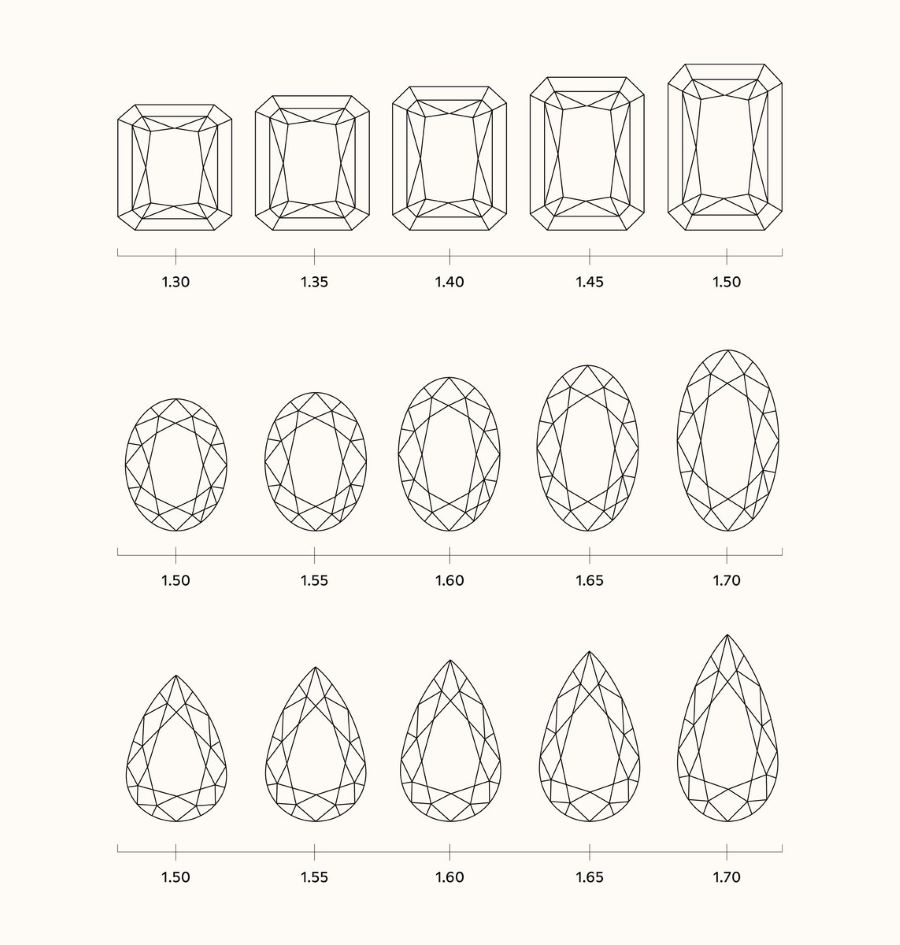
When people talk about the "ratio" of an engagement ring diamond, they mean the length-to-width ratio: a simple number that describes the shape of the stone. You get it by dividing the stone's length by its width.
A ratio of 1.0 means perfectly square or round. A ratio of 1.5 means the stone is 50% longer than it is wide. That's it. There's no magic formula, it's just a shape descriptor.
Ratio = length ÷ width. A 9mm × 7mm oval has a ratio of 1.29. A 10mm × 7mm oval has a ratio of 1.43. Simple.
Social media. People see a ring they love on Instagram or Pinterest, find out it's an oval with a "1.50 ratio" and assume that's the secret ingredient. The truth is that ratio is just one piece of a much bigger picture.
What most people are actually trying to achieve when they ask about ratio is one of these things:
→ They want the stone to look more elongated and finger-flattering.
→ They want the stone to look larger for its carat weight.
→ They saw a specific shape online and want to recreate it.
All valid goals; ratio just isn't always the right lever to pull to get there.
Different cuts have different "sweet spots" — ranges where most people agree the shape looks its best. These aren't rules, just starting points.
| Shape | Sweet Spot | What Changes Outside It |
|---|---|---|
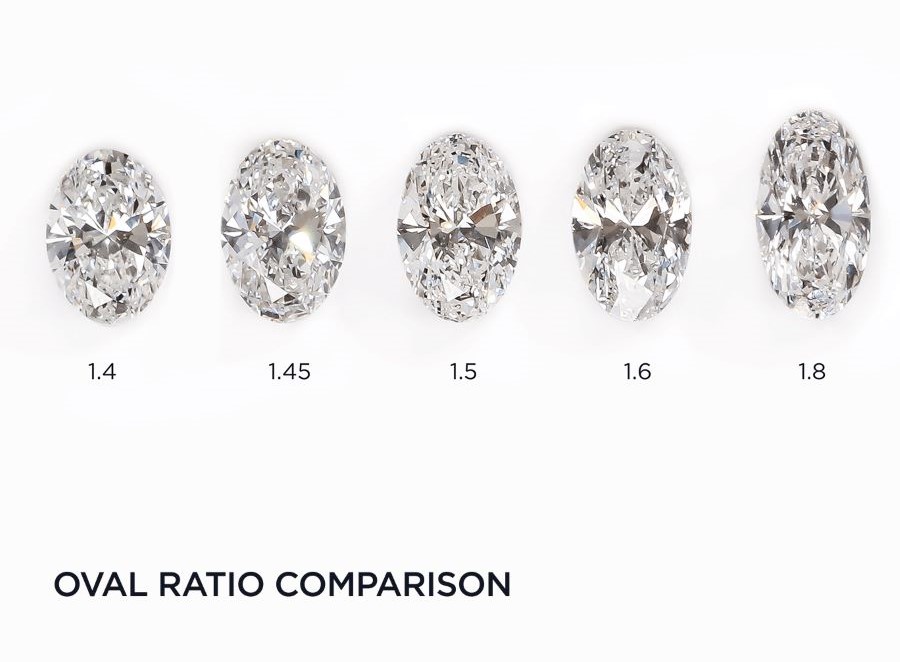
| Oval (Popular) | 1.35 – 1.50 | Too low = looks round. Too high = looks thin and narrow. |
| Round | 1.0 (always) | By definition it's always 1:1. Ratio doesn't apply here. |
| Pear | 1.45 – 1.75 | Below 1.45 = stubby. Above 1.75 = very elongated, divisive. |
| Marquise | 1.75 – 2.15 | Below 1.75 = chunky. Above 2.15 = very narrow, fragile tips. |
| Emerald | 1.30 – 1.50 | Outside this range the step-cut facets look unbalanced. |
| Cushion | 1.0 – 1.10 | Most people want near-square. Above 1.10 = elongated cushion. |
Honest answer: the one that looks right to your eye on your hand. But here are the questions that actually help narrow it down:
Higher ratio = more elongated stone = fingers can appear longer and slimmer. An oval at 1.50 will be more dramatically elongating than one at 1.35.
Elongated ratios tend to have more surface area for the same carat weight, so a 1.50 oval will often look larger face-up than a 1.35 oval of the same carat.
If you can try stones in person, ignore the ratio number and just look. If you're buying online or custom, ratio gives you a useful shorthand to communicate what shape you want.
Chasing a specific number. Ratio is a guide, not a guarantee. Two ovals with the same ratio can look completely different depending on how they're cut, their depth, and their shoulder shape.
Ignoring their hand. A high-ratio stone on a wider hand may not elongate the finger the way you expect. A lower-ratio stone on a slender hand can look beautifully proportioned.
Forgetting the setting. A solitaire setting shows off ratio very differently than a halo or trilogy. The ring around the stone changes the overall silhouette significantly.
Though personal taste varies, ideal oval diamond ratios usually fall between 1.35 and 1.50. This range ensures a harmonious balance, providing elegance without appearing too stretched or squat.
Generally yes: elongated stones tend to have more face-up surface area for the same carat weight. But cut quality and depth also affect how large a stone appears, so ratio alone doesn't tell the whole story.
Not directly. Price is driven by the 4Cs (cut, colour, clarity, carat). Ratio is a by-product of how the stone was shaped, not a graded quality in itself.
No: ratio only describes length vs width (the outline shape). Proportions refer to depth, table size, and facet angles, which affect how the stone handles light. Both matter, but they're different things.
Yes, and it's a great way to communicate the shape you want. Just know there's always a small tolerance; natural diamonds aren't cut to the millimetre. A bespoke lab diamond can get closer to an exact ratio.
The stone's ratio is the same regardless of metal, but the overall visual impression can differ. Yellow gold can make a stone's outline appear warmer and softer; white gold tends to make it look crisper and more defined.