
- Need Help?
 Virtual Appointment
- Book Appointment
- 0
 Your shopping cart is empty
Login to view previously saved items or track a recent order.
Login to view previously saved items or track a recent order.
 Back
Back03/04/2026
Let's be honest: when you're standing in a jewellery shop (or scrolling at 1am), the difference between 14K and 18K gold feels like one of those things you're supposed to already know. You don't want to ask. We get it. So, here's the full breakdown, the way Hari, our owner at Harmony Jewels, would explain it to a friend over a cuppa.
The short version? There's no objectively better option here. It's a personal choice that comes down to your lifestyle, your skin, and how you wear your jewellery. But read on, because there's a fact about 18K gold that genuinely surprises most people.
The "K" stands for karat; a measure of how much pure gold is in your piece. Pure gold is 24 karats. So:
The remaining percentage is made up of other metals: silver, copper, zinc, or palladium. These aren't fillers. They're what give your jewellery its strength, colour, and durability.
In the UK, you'll also spot hallmark stamps reading 585 (14K) or 750 (18K) which are the European equivalents, referring to parts per thousand.
Here's the thing that catches most people off guard: 14K gold is actually harder and more durable than 18K gold.
More gold sounds better. But pure gold is naturally a very soft metal; and the higher the karat, the softer your piece. The alloy metals in 14K gold are precisely what make it tougher.
This is backed up by the numbers. On the Mohs scale of mineral hardness (the standard measure used by gemologists), 14K gold scores between 3.5 and 4, compared to 2.5 to 3 for 18K. In practical terms, 14K gold can withstand significantly more force before denting or losing its shape.
Here's what makes Harmony Jewels different: we'll actually tell you this. Hari, our owner, is refreshingly direct about something many jewellers would rather you didn't know:
"Most people tend to think that 18 karat is higher quality than 14, and when I say higher quality, they mean better for daily wear. However, this couldn't be more wrong. Pure gold is incredibly soft, malleable with bare hands. Therefore, the higher the gold content, the softer the piece will be. Hence, 14 karat is more durable and better suited for daily wear.
Unfortunately, a lot of jewellers try to push 18 karat over 14, trying to sell you the more expensive item, something that is totally unnecessary. It's absolutely fine to buy 18 karat for daily wear. But it's important to understand what the better option actually is, and what is more suitable for you."
That kind of honesty is rare in the jewellery industry. At Harmony Jewels, we'd rather you walk away with the right piece than the most expensive one.
This is one of the most common concerns we hear, and it deserves a direct answer.
Some jewellers will tell you that 14K gold is more brittle than 18K. Hari has something to say about that:
"Other jewellers may say that 14 karat is brittle. However, this is not the case. It is probably their casting method that is not up to the highest standard available with the latest technology today. At Harmony Jewels we've been casting in 14 karat for several years and we simply do not have this problem.
14K gold means approximately 58% pure gold — but different casting companies use different alloys for the remaining percentage, and that is where brittleness can come from. The alloy composition matters enormously, as does the casting technology itself. All of these factors must be taken into account. At Harmony Jewels, we use the greatest and latest casting technology available in the world today."
This is a crucial point. 14K gold is not inherently brittle. Brittleness in gold jewellery is a manufacturing issue: a result of inferior alloys or outdated casting processes. It is not a property of the karat itself.
When you buy from Harmony Jewels, you're not just buying gold. You're buying the expertise, the materials, and the technology that go into making it right.
One thing that often surprises people when they see both side by side in person is the colour. 18K gold has a richer, deeper yellow tone, which makes sense, since it contains more pure gold. 14K, on the other hand, has a slightly cooler, more muted hue.
And here's something Hari notices time and again in the shop: once customers actually hold both pieces, many find themselves drawn to 14K. Not for the price, not for the durability, but purely for the colour. That slightly less intense yellow tends to feel more wearable to them, easier to mix with other metals, and a better match for everyday style.
So if you've always assumed that more gold means more desirable, it's worth seeing them together before you decide. Your eyes might surprise you.
| 14K Gold | 18K Gold | |
|---|---|---|
| Gold Content | 58.3% | 75% |
| Hardness (Mohs) | 3.5–4 | 2.5–3 |
| Durability | Higher | Lower (softer) |
| Colour | Slightly lighter | Richer, deeper tone |
| Allergy risk | Slightly lighter | Lower |
| Price | More affordable | 25–30% more expensive |
| Best for | Daily wear, active lifestyles | Special occasions, sensitive skin |
| Hallmark stamp | 585 | 750 |
14K gold, every time.
If you wear your rings whilst washing up, your bracelets at the gym, or your earrings 24/7, 14K is built for that life. Its higher alloy content makes it far more resistant to the scratches, knocks, and dents of daily living.
This is exactly why 14K gold is the most popular choice for engagement rings and wedding bands in the UK; pieces that are meant to be worn continuously for decades, through everything life throws at you.
Jewellers also report far fewer repairs on 14K pieces compared to higher karat options. That's worth thinking about over a lifetime of wear.
This is the big one; and it's where the durability conversation really matters.
14K gold is the most popular choice for engagement rings in the UK, and for good reason. An engagement ring is worn every single day; through hand washing, cooking, the gym, typing, everything. The extra hardness of 14K means it holds its shape better, shows fewer surface scratches, and requires less maintenance over the years.
18K is a wonderful choice if:
Both make for a beautiful, meaningful engagement ring. But if your partner is active or works with their hands, 14K is genuinely the more practical choice for everyday wear.
If you've ever had a reaction to jewellery; redness, itching, or a rash, it's almost always caused by alloy metals, particularly nickel.
Because 18K gold contains fewer alloys (only 25% compared to 41.7% in 14K), it is generally less likely to trigger a reaction. If you have a known metal sensitivity, 18K is the safer option or speak to us about alloy compositions, as not all gold jewellery contains nickel.
Absolutely. 14K gold contains 58.3% pure gold and is fully certified, hallmarked fine jewellery. It is one of the most widely sold and trusted gold standards in the UK and globally. Don't let anyone suggest otherwise.
No. Not in the way costume jewellery can. 14K gold may very gradually develop a slight patina over decades of heavy wear, but it won't discolour your skin. (Green skin is caused by base metals, not gold alloys.) A professional polish restores it easily.
Generally, yes. The higher gold content means fewer alloy metals that can trigger reactions. If you have a nickel sensitivity in particular, 18K is worth the investment, or ask your jeweller specifically about the alloy mix used.
You can, but be aware it's softer and will show surface wear more readily than 14K under daily rough use. If you're active or wear your jewellery non-stop, 14K is the more practical choice.
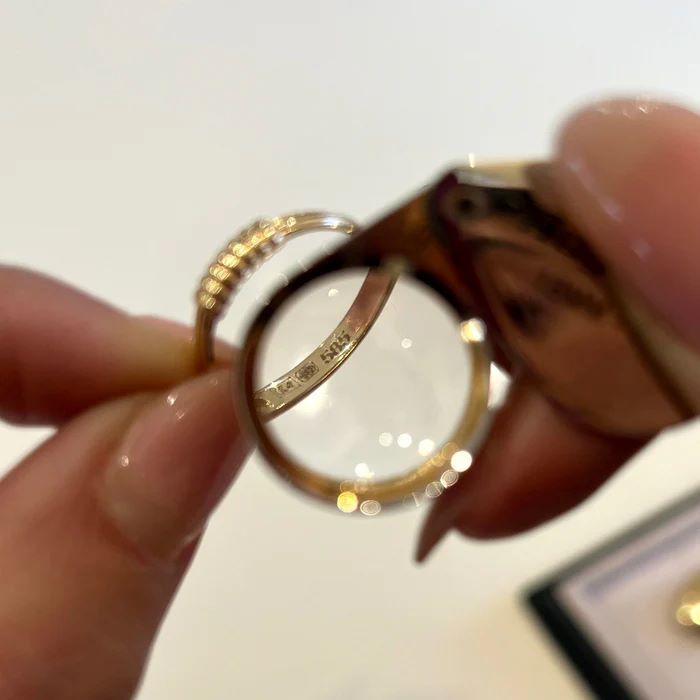
Look for a hallmark stamp: a tiny marking inside a ring band, on a bracelet clasp, or on the back of an earring post. You'll see 14K or 585 for 14 karat, and 18K or 750 for 18 karat.
14K is the most popular choice in the UK for engagement rings due to its durability and value. 18K suits those who prefer a richer colour or have sensitive skin. Both are excellent. The right choice depends on your lifestyle and priorities.
Both are typically rhodium-plated, giving them the same bright white appearance. Over time, as the rhodium wears off, 18K white gold will show a slightly warmer undertone, while 14K may appear slightly more silvery. Both can be re-plated by a jeweller to restore the original finish.
No! And this is an important myth to clear up. Brittleness in gold jewellery is not caused by the karat; it's caused by poor alloy composition or outdated casting techniques. At Harmony Jewels, we use premium alloys and the latest casting technology, and we have never experienced this issue with our 14K pieces. If a jeweller tells you 14K is brittle, it's worth asking about their manufacturing process.
We wrote this article because we believe you deserve the full picture and not a version of it that nudges you towards spending more. The jewellery industry, like any industry, has its upselling habits. At Harmony Jewels, we're not interested in that.
Our job is to help you find the piece that's right for your life, your budget, and the person you're buying for. Sometimes that's 14K. Sometimes that's 18K. What matters is that you understand the difference and make the choice that genuinely suits you. No pressure, no agenda, just honest advice from people who genuinely love jewellery.
Whether you're just starting to research, already know exactly what you want, or somewhere in between, we'd love to help.
Come and see us in person at our Hatton Garden showroom, the heart of London's jewellery quarter. Browse our collection, try pieces on, and speak directly with our experts, including Hari himself.
Can't make it in person? Book a free 5-15 minute virtual consultation with one of our specialists. We'll walk you through your options, answer every question, and make sure you feel completely confident before you commit to anything.
Because the right piece of jewellery isn't just about karats. It's about the story it's going to tell — and we'd love to help you tell it.